My Guide For Best Metal Detector For Beginners In 2025

Written by Piotr Lesniewski
Detectorist • Scotland
As an Amazon Associate we earn commission from qualifying purchases. Read our full Affiliate Disclosure.
Over the years, I’ve helped countless novice metal detectorists get started, and I’ve learned a thing or two about what makes the best metal detector for beginners. I’ve seen the confusion, the questions, and the excitement, and that’s why I’ve put this guide together – to cut through the noise and give you honest, practical advice from someone who’s been there.
This guide is all about getting you, a beginner metal detectorist kitted out with the right metal detector in 2025 without breaking the bank or getting bogged down in tech-speak.

My Top Metal Detector Picks for UK Beginners in 2025
Right, let’s get to the heart of it – the metal detectors themselves! I’ve picked out four detectors that I reckon are spot-on for beginners in the UK for 2025. I’ve chosen them to cover different needs and budgets.
I’ve had a swing with each of these models over the years, so I’m giving you my honest take.
Minelab Vanquish 540
Best Overall Value for Money Metal Detector For Beginners
As an Amazon Associate we earn from qualifying purchases.
I Recommend This If...
- Unbeatable all-round performance for the price in diverse UK conditions.
- So simple to use, you’ll be finding interesting items on your very first trip out.
- Light enough to carry and swing for hours without tiring you out.
- Handles tricky UK beaches and mineralised ground like a much more expensive machine.
Best Overall Value for Money Metal Detector For Beginners: Minelab Vanquish 540
If I had to recommend one metal detector for beginners that hits that sweet spot of performance, ease of use, and price in 2025, it’d be the Minelab Vanquish 540.
I’ve seen so many new metal detectorists thrive with this machine. What really sets it apart for me is Minelab’s Multi-IQ technology.
In simple terms, it’s like having several detectors in one, and it handles our varied UK soils – "from mineralised farmland to wet sand on the beaches" – brilliantly, straight out of the box.
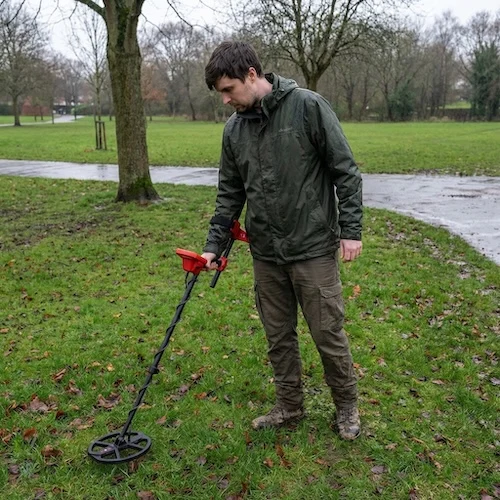
This ability to perform across different terrains without needing constant fiddling is a massive plus when you’re learning.
It’s lightweight, around 1.2 kg, so you can swing it all day without your arm feeling like it’s about to drop off.
And it’s just dead easy to get to grips with, even if you’ve never touched a metal detector before.
Many customers report back that it’s perfect for a complete beginner but highly regarded by more experienced detectorists too.
I’ve found everything from hammered pennies to older silver shillings with Vanquish machines, and they rarely disappoint.
It often comes with essentials like wired headphones and a rain cover, adding to its value.
Minelab X-Terra Pro
Best High-End Metal Detector For Beginners
As an Amazon Associate we earn from qualifying purchases.
I Recommend This If...
- Unbeatable all-round performance for the price in diverse UK conditions.
- Offers advanced features like switchable frequency that will keep you challenged and help you develop your skills.
- Properly waterproof design opens up far more detecting possibilities in and around UK waters.
- A solid, future-proof investment that you won’t outgrow quickly, offering performance that punches well above its price.
Best High-End Metal Detector For Beginners: Minelab X-Terra Pro
Now, if your budget can stretch a bit further and you’re serious about getting a beginner metal detector that will grow with you, the Minelab X-Terra Pro is a cracker.
I’ve been really impressed with what Minelab have packed into this for the price. It’s got their PRO-SWITCH technology, which means you can change the operating frequency ("selectable between 5, 8, 10, or 15 kHz").
This is brilliant because it lets you fine-tune the metal detector for different types of targets or ground conditions – a feature usually reserved for much pricier machines and a real advantage for tackling varied UK sites.
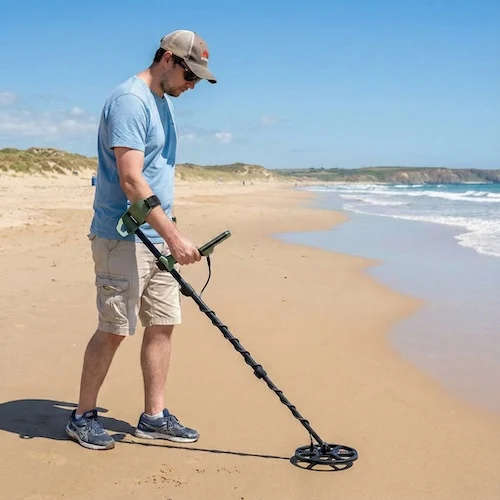
It’s also fully waterproof up to 5 metres ("IP68 rated"), so you can properly wade into those rivers or hit the surf with confidence, opening up more beach metal detecting opportunities.
It feels robust, has a great clear LCD display with a backlight and even a control pod flashlight for when the light fades. The audio control is excellent, helping you distinguish trash from treasure and even gauge size and depth.
While it has many features, which might seem a little confusing at first, it’s still very manageable for a keen beginner metal detectorist willing to learn.
It’s lightweight at around 1.3kg and collapses for easy transport.
Nokta Simplex Ultra
Best Mid-Range Metal Detector For Beginners
As an Amazon Associate we earn from qualifying purchases.
I Recommend This If...
- Incredible value, packing in a host of features (like full waterproofing and carbon shaft) usually found on much more expensive detectors.
- Properly waterproof and robustly built, making it suitable for all typical UK detecting conditions, rain or shine, land or water.
- Lightweight and comfortable to use, perfect for those long, enjoyable detecting sessions.
- Simple enough for a beginner to pick up and use effectively from day one, but with enough depth in its settings to keep you learning and improving.
Best Mid-Range Metal Detector For Beginners: Nokta Simplex Ultra
The Nokta Simplex range has been a real game-changer for affordable, quality adult metal detectors, and the Nokta Simplex Ultra is, in my opinion, the pick of the bunch for a mid-range beginner metal detector.
I’ve recommended Simplex models to loads of customers starting out, and they’ve been chuffed.
What you get for your money is fantastic: it’s fully waterproof up to 5 metres ("IP68"), which is brilliant for UK beaches and rivers.
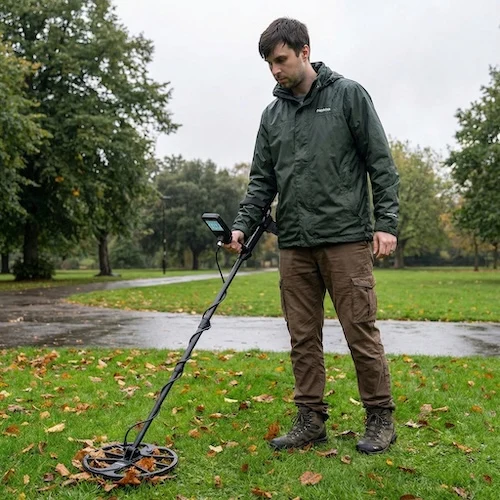
It’s incredibly lightweight at just 1.2kg, largely thanks to its carbon fibre shaft – a feature you’d usually expect on more expensive models.
It’s packed with features like multiple search modes ("Field, Park, 4 Tone, 99 Tone, Beach, All Metal"), vibration for noisy environments or underwater use, a backlit keypad, LCD backlight, and even an LED flashlight.
It’s rechargeable via USB too, which is a big plus for convenience and saving on battery costs.
It’s a very capable machine on both land and beach, and it’s simple enough with its turn-on-and-go operation to get going quickly, but has enough settings to tweak and learn as your skills develop.
The WHP (Wireless Headphone Package) version is also available if you want to go cord-free.
DR. ÖTEK MT-XR
Best Budget Metal Detector For Beginners
As an Amazon Associate we earn from qualifying purchases.
I Recommend This If...
- Gets you into the hobby of metal detecting for a very low initial cost, perfect for testing the waters.
- Often comes as a complete kit with all the basic accessories you need to start right away.
- The waterproof coil lets you try out beach detecting and searching in damp UK conditions.
- Simple enough for anyone, including older children, to pick up and start having fun finding things.
Best Budget Metal Detector For Beginners: DR. ÖTEK MT-XR
If you’re looking to dip your toe into metal detecting without spending a lot, or perhaps you’re buying for a younger enthusiast just starting out, the DR. ÖTEK MT-XR is one I’ve seen pop up a lot and it gets surprisingly decent feedback for its price.
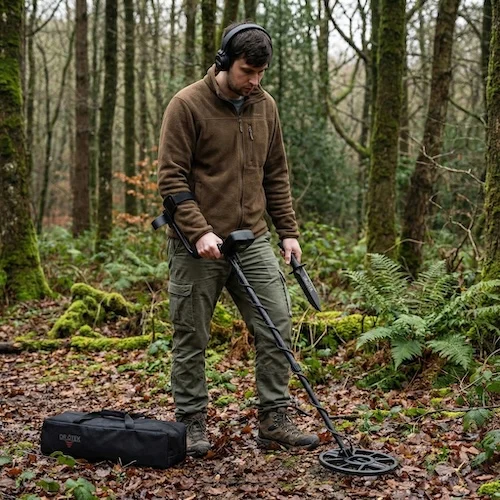
Now, let’s be clear, it’s not going to compete head-to-head with the Minelabs or Noktas in terms of sheer depth or advanced features, but for much less when it’s on offer, it’s a capable starter.
I’ve seen these come as a kit with headphones and sometimes a little digging tool and carry bag, which is really handy for a beginner.
The search coil is IP68 waterproof, so you can paddle at the beach or search damp ground without worry (though the control box isn’t waterproof, so keep that dry!).
It’s got a clear, large backlit LCD display showing depth, object detection, and sensitivity, different modes including pinpoint and an exclusive memory mode, and it’s pretty lightweight at around 1kg.
For a beginner level metal detector to see if you enjoy the hobby without a big outlay, it’s a solid entry point and customers report it’s easy to operate.
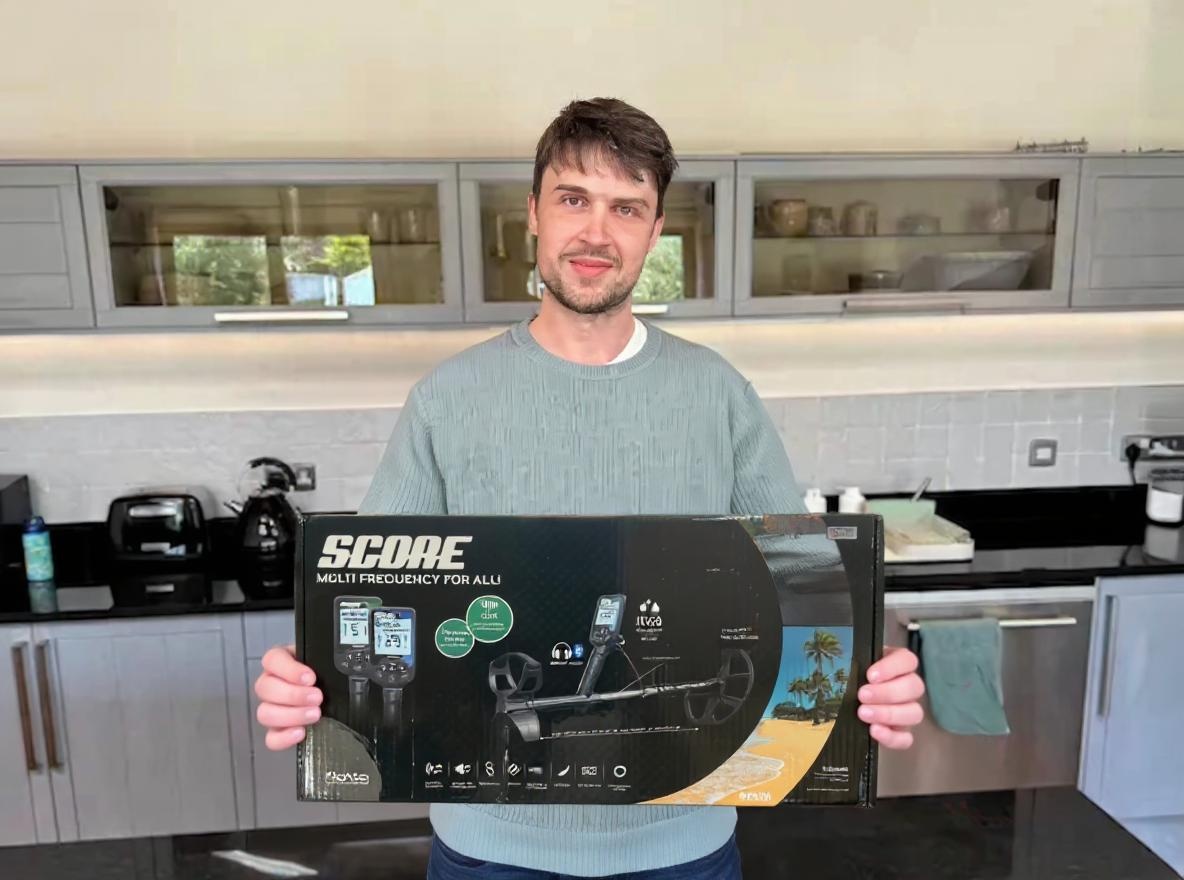
What to Look For When Picking Your First Metal Detector
Choosing your first metal detector as a complete novice can feel a bit daunting with all the jargon flying about.
But don’t you worry, I’m here to break down the key things you, as a UK beginner, should be looking for.
It’s not about having the fanciest machine with a million buttons; it’s about getting the right tool for the job that you’ll enjoy using and that will actually find things in our varied UK ground.
Key Metal Detector Features Explained Simply:
Discrimination
This is your best mate for avoiding digging up every rusty nail and bottle cap!
Discrimination allows your detector to tell the difference between types of metal and ignore the rubbish, or “junk” targets. Good discrimination means less time digging unwanted items and more time focusing on potentially interesting finds.
Most beginner metal detectors have pre-set modes that help with this, like ‘Coin‘ or ‘Jewellery‘ modes, which automatically filter out common trash signals.
Learning how your machine’s discrimination works is key to more successful hunts.
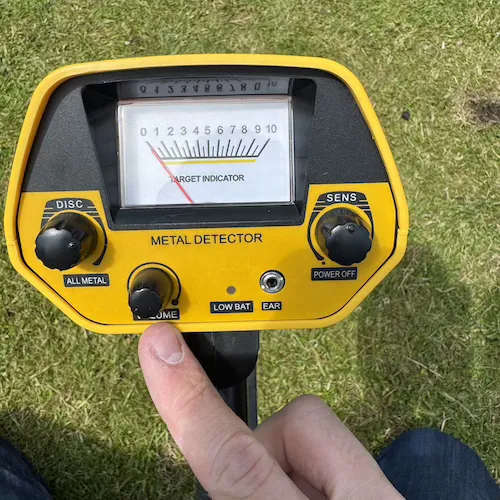
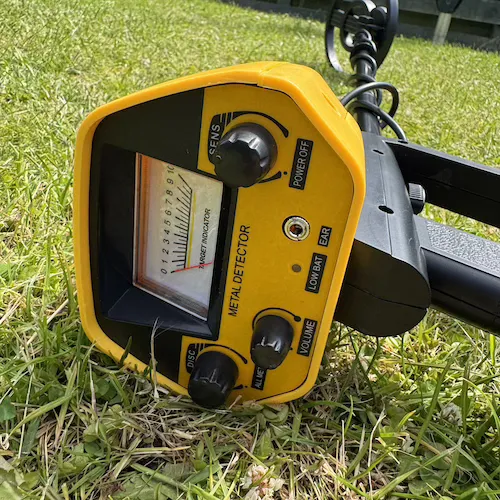
Sensitivity
Think of this like the volume control for signals. Higher sensitivity means it can pick up smaller or deeper targets.
But, and this is a big “but” especially in the UK, if you crank it too high, particularly in areas with lots of electrical interference (near power lines, for example) or highly mineralised soil (which we have plenty of!), your metal detector will chatter away with false signals, making it hard to hear genuine targets.
You want a machine with adjustable sensitivity so you can find that sweet spot for the conditions you’re in.
Starting around 75% and adjusting from there is often a good approach.
Ground Balance
Our UK soil can be a tricky beast – some areas are full of minerals that can confuse your detector, making it beep when there’s no metal there, or masking good targets.
Ground balance tunes your machine to ignore these ground minerals, so it can focus on finding actual metal targets.
Many beginner detectors have automatic ground balance, which is great as it does the work for you.
Some mid-range ones might offer manual adjustment too; this can give you an edge in particularly challenging ground once you learn how to use it effectively, potentially increasing depth.
Frequency (Single, Multi, Switchable)
This is about the ‘radio wave’ the detector sends into the ground to find metal.
Different frequencies have different strengths:
Single Frequency: Most budget and some mid-range machines operate on one fixed frequency. These can be very effective, with lower frequencies generally better for deeper, larger, and more conductive targets like silver, while higher frequencies are more sensitive to smaller targets like tiny coins or gold.
Simultaneous Multi-Frequency: These advanced machines, like the Vanquish 440, send out multiple frequencies at the same time. This makes them brilliant all-rounders, especially good on beaches and in varied or mineralised soils, as they’re effectively looking for a wide range of targets simultaneously.
Switchable Frequency: These detectors let you choose which single frequency to use from a selection. This gives you the versatility to optimise your detector for specific conditions or target types.
Coil Size and Type
The coil is the round (or elliptical) bit at the bottom that does the searching.
Size: Larger coils generally cover more ground and can detect targets deeper. Smaller coils are better for “trashy” areas as they can separate individual targets more easily. A good all-round size for a beginner is often in the 9-11 inch range.
Waterproof Coil: This is absolutely essential in the UK! Even if you don’t plan on wading into rivers, you’ll encounter damp grass and muddy fields. Make sure at least the search coil is waterproof.

Weight and Ergonomics
You’ll likely be swinging your detector for several hours, so a lighter machine (ideally around 1kg to 1.3kg) is much kinder on your arm, shoulder, and back.
Also, check that the stem is adjustable in length to suit your height properly. A comfortable machine is one you’ll use more often.
Pinpoint Feature
Once your detector beeps, the pinpoint function helps you narrow down exactly where the target is. This means you can dig a smaller, neater hole. Most decent beginner machines have this feature, and it’s a massive help.
Budget Considerations for a Beginner Metal Detector:
You don’t need to spend a fortune to get a good starter metal detector that will find you interesting things.
My advice?
Set a budget you’re comfortable with for the detector itself, and importantly, remember to factor in a few essential accessories like a pinpointer and a good spade, as these will significantly improve your experience.
My Top Tips for Your First Few Outings With Your Metal Detector
So, you’ve got your beginner metal detector and your gear – exciting times are ahead!
Those first few trips out are all about learning, experimenting, and most importantly, having fun. Don’t go out expecting to dig a Roman gold hoard on day one (though, you never know your luck!).
Here are a few of my top tips to help you get started on the right foot:
Get to Know Your Machine (Before You Go Out!)
Read the manual! I know, it sounds boring, but it’s genuinely important.
If you have a garden, try burying a few different metal items – like a modern coin, an old copper coin, a ring pull, a nail, and a piece of foil – at different, known depths. Then, sweep over them with your detector. Listen carefully to the different tones and look at the target ID numbers. This “test garden” will help you understand how your detector responds before you even set foot on a permission.
Proper Swing Technique – Slow and Low
This is fundamental. Keep your search coil close to the ground, ideally about an inch or so above it, and keep it parallel to the ground throughout your swing.
Swing slowly and methodically from side to side, overlapping each sweep slightly. A common mistake is to swing too fast or to lift the coil at the end of each swing like a pendulum – both will reduce your detection depth.
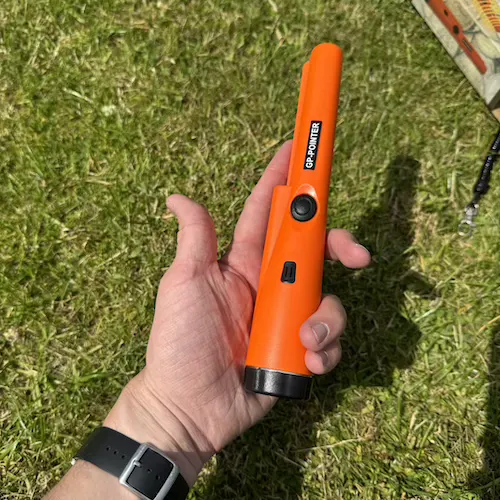
Pinpointing and Target Recovery – Digging Neat Holes!
When you get a good, repeatable signal, use your pinpoint function. Move your coil in an ‘X‘ pattern over the target to find the loudest spot.
For grassy areas, carefully cut a U-shaped plug of turf. Hinge it back carefully, retrieve your target, and then replace the plug neatly. This is SO important for keeping landowners happy.
Dealing with Trashy Signals – It’s Part of the Game
You WILL dig a lot of junk. It’s all part of the learning curve. Don’t get disheartened!
Pay close attention to what your detector tells you. Over time, you’ll get better at distinguishing good targets from rubbish. And remember the golden rule: always take all your dug rubbish home with you.
Patience and Persistence – The Key to Success
Metal detecting is a hobby of patience. Some days you’ll find lots, other days very little. That’s just the way it is.
Don’t get discouraged! Every trip is a chance to learn. The more you go, the more experience you gain, and often, the “luckier” you’ll get.
Research Your Permissions
Once you have permission, try to research its history. Old maps, local history websites, and chatting with the landowner can give you clues about where people might have lived, worked, or lost things. This can make your detecting much more targeted and exciting.

The Important Bit: Metal Detecting Legally and Ethically in the UK
Now, this is arguably the most important section of all.
Metal detecting in the UK is a privilege, not a right, and every one of us has a responsibility to conduct ourselves legally and ethically.
Landowner Permission is EVERYTHING
This is the absolute golden rule: You MUST have explicit permission from the landowner before you set foot on any piece of land.
This applies to all land – farmland, woodland, parks, and even beaches above the mean high water mark that are not part of the Crown Estate. Trespassing with a metal detector is illegal. It’s always best to get permission in writing.
The Treasure Act 1996 Explained Simply
If you find something that could be legally defined as ‘Treasure’, you are legally obligated to report it within 14 days. This report must be made to the local Coroner.
What generally counts as Treasure in England, Wales, and Northern Ireland?
Any metallic object (other than a single coin) at least 300 years old and with at least 10% gold or silver.
Any group of two or more prehistoric metallic objects from the same find.
Groups of two or more coins from the same find, at least 300 years old, with at least 10% gold or silver. If there are 10 or more coins, they can be any metal.
Any object found with another object that is Treasure.
Objects less than 300 years old, made of gold or silver, deliberately hidden, and whose owners are unknown.
Failing to report Treasure is a criminal offence. Scotland has its own, different system called Treasure Trove.
Reporting Your Finds with the Portable Antiquities Scheme (PAS)
Even if your finds don’t qualify as ‘Treasure’, it’s incredibly important to record them with the Portable Antiquities Scheme (PAS). Your local Finds Liaison Officer (FLO) is the person to contact. This information is vital for archaeologists and historians.
The NCMD Code of Conduct – Your Guiding Principles
The National Council for Metal Detecting (NCMD) has an excellent Code of Conduct that all responsible detectorists should follow.
Key principles include:
Always obtain permission.
Do not detect on Scheduled Monuments or other protected sites without lawful authority.
Always fill in your holes neatly.
Take all litter and dug rubbish home.
Report all finds that might be Treasure.
Respect the Countryside Code.
Joining the NCMD is a very good idea. Membership provides essential public liability insurance, which many landowners require.
Respecting the Countryside and Archaeological Sites
Always be mindful of your surroundings. Leave gates as you find them. Do not disturb livestock or damage crops.
If you discover anything that looks like human remains, or any live ammunition, stop digging immediately. Do not touch it. Mark the site and immediately inform the police and the landowner.
Quick Summary
| Rank | Detector | Amazon Link |
|---|---|---|
| #1 | Minelab Vanquish 540 Best Overall Value for Money Metal Detector For Beginners | View On Amazon |
| #2 | Minelab X-Terra Pro Best High-End Metal Detector For Beginners | View On Amazon |
| #3 | Nokta Simplex Ultra Best Mid-Range Metal Detector For Beginners | View On Amazon |
| #4 | DR. ÖTEK MT-XR Best Budget Metal Detector For Beginners | View On Amazon |
As an Amazon Associate we earn from qualifying purchases.
Final Thoughts and Happy Hunting!
Well, there you have it – my comprehensive guide to choosing the best beginner metal detector and getting started in this brilliant hobby.
The most important thing is to choose a machine you feel comfortable with, take the time to learn it, get permission, and then just get out there and enjoy yourself!
Don’t be afraid to ask questions. Consider joining a local metal detecting club – they are a fantastic source of advice and camaraderie.
So, do your research, get your kit, secure your permissions, and then get out there and start your adventure. I truly hope this guide has been helpful. Happy hunting, and may your finds pouch always be heavy with interesting discoveries!
Author Profile
Piotr Lesniewski
"Digging up the past, one signal at a time."
Polish-born, Scotland-based, and obsessed with the beep. My passion began decades ago, exploring fields with my Dziadek (grandfather). Now, with over 10 years of digging under my belt, I'm here to share everything I've learned—unfiltered and unbiased—to help you unearth your own piece of history. No sales pitches, just real field experience.